46.04432, -93.56044
Establish oak regeneration while comparing several different silvicultural strategies and techniques.
47.5043, -91.9072
Increase stand resilience by increasing species diversity (promoting cool climate-dependent tree species) and structural complexity following a commercial timber harvest.
47.362925, -91.043965
Increase stand resilience by increasing species diversity (promoting cool climate-dependent tree species) and structural complexity through brush control site preparation and artificial regeneration (conifer planting).
47.103709, -91.572081
Enhance current and future species diversity and structural complexity by ensuring successful tree recruitment into sapling/small tree size classes currently absent from the stand.
43.846417, -92.18994
Use a prescribed burn followed by direct seeding to return a reed canary grass area to bottomland hardwood.
46.11981, -90.423044
Manage Pennsylvania sedge and ironwood in order to facilitate northern hardwood regeneration.
43.842362, -92.18504
To return areas with dense reed canary grass to bottomland hardwood forests.
46.101808, -92.481827
To use a two-cut shelterwood system with deer browse protection (exclosures) to maintain northern red oak as a component of Central Dry-Mesic Oak-Aspen-Red Maple Forest
45.398925, -93.712896
Reduce buckthorn and other shrub competition and establish planted red pine seedlings in a recently harvested oak stand transitioning to oak-pine mixed species stand
44.5806, -92.6123
Regenerate a mature lowland hardwoods stand to a young stand of similar composition.
44.621295, -92.66885
Regenerate a mature lowland hardwoods stand to a young stand of similar composition.
44.212176, -91.921667
Keep the site forested and increase resilience by improving diversity and removing invasive species.
47.666, -91.271
Use an interdisciplinary approach to create a large young forest patch more representative of natural disturbances in boreal landscapes.
44.944403, -93.048165
To restore native plant communities and habitats by removing both native and exotic woody vegetation as well as to utilize the removed biomass material for bioenergy.
45.313064, -93.79872
To restore native plant communities and habitats by removing both native and exotic woody vegetation as well as to utilize the removed biomass material for bioenergy.
44.869536, -88.904822
Better understand the relationship between Carex pennsylvanica and Carex pedunculata, deer browse, and regeneration of quality northern hardwood species in a way to create future management options to promote seedling success.
46.646648, -92.650839
Use residual patches of eastern white pine within aspen stands for future natural regeneration. Aspen stand to be harvested while white pine seedlings establish.
44.523547, -92.435569
Regenerate a mature red oak stand to a young stand of similar composition, using natural regeneration with well-timed mechanical site preparation.
46.761258, -92.743935
Determine best silvicultural method for paper birch regeneration.
46.775838, -94.890726
Measure ecological recovery following stand reinitiation and site preparation
48.608, -95.18311
Increase biological diversity of a young jack pine stand through prescribed burning.
48.606297, -94.975009
Increase heterogeneity and complexity of stand structure and composition while providing variable canopy cover, density of residual trees, and understory plant community development; establish openings (and later expand) to facilitate regeneration.
47.24034, -93.13845
Use natural and artificial regeneration practices to regenerate a natural origin red pine site with characteristics that mimic a natural origin stand in structure and diversity, while maintaining red pine as the dominant species.
44.665304, -92.731634
Regenerate mature lowland hardwood stands to young stands of similar composition.
43.77772, -91.17246
Establish a fully stocked stand of naturally and artificially occurring floodplain forest tree species on a former hayfield now dominated by invasive reed canary grass through site preparation and direct tree seeding.
47.715497, -90.87606
Establish an even-aged mixed woods stand comprised of jack pine, aspen, paper birch, and balsam fir.
47.715497, -90.87606
Establish an even-aged mixed woods stand comprised of aspen, white spruce, balsam fir, and white pine.
47.715497, -90.87606
Establish white pine as a dominant overstory species.
43.028782, -90.842558
The goal of this harvest is to regenerate the oak/hickory type, encouraging all oak species.
44.257998, -85.779799
Objectives of this stand include a shelterwood harvest, tending of the stand via understory cutting, constructing a slash wall for deer exclusion, and evaluating the effectiveness of excluding deer and the natural regeneration success.
43.852085, -91.485022
Regenerate a mature oak stand to a young stand of similar composition.
46.417805, -92.02313
Maintain the northern hardwood timber type through an even-aged silvicultural system of shelterwood with reserves.

Assessing the success of group openings in recruiting mid/intolerant deciduous tree species (Haliburton Forest and Wild Life Reserve)
In this field trial, we investigated the effects of group opening treatments on the regeneration of yellow birch, black cherry, and red oak in Haliburton Forest and Wild Life Reserve, 2-3 years after implementation of the group openings.
Cover type: Northern hardwoods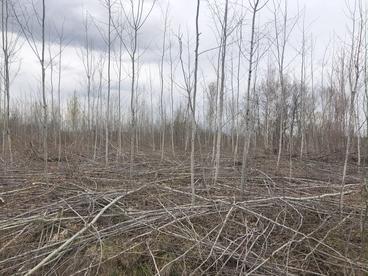
Pre-commercial aspen thinning (UPM Blandin)
Utilize pre-commercial thinning in a quaking aspen (Populus tremuloides) stand to increase diameter growth and decrease rotation age.
Cover type: Aspen-Birch
Swamp tree planting using mounding (Fond du Lac)
Restore this wetland to a culturally useful forested condition that is more resilient to human stressors, particularly climate change, than the previous forest.
Cover type: Ash
Comparing Pine Regeneration Methods and Tactics in the Cloquet Valley State Forest (MN DNR)
The goal on all three stands was to decrease the overall abundance of trembling aspen, paper birch, and balsam fir while increasing the abundance of long-lived conifers such as red pine, white pine, white, and black spruce.
Cover type: Pine
Goose Island Deer Repellent Test (US Army Corps)
The objective of the planting was to test the effectiveness of deer fence and animal protein-based deer repellent on growth and survival of swamp white oak and river birch seedlings.
Cover type: Other
Mississippi River Pool 3 Floodplain Forest Silvicultural Trials (US Army Corps of Engineers)
Promote regeneration of floodplain tree species and prevent conversion of site to reed canary grass. Provide wildlife habitat for the next 50 to 100 years.
Cover type: Other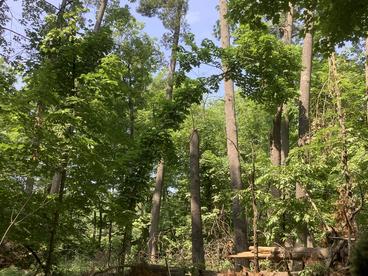
Variable Overstory Density Management for White Pine Regeneration in Two Native Plant Communities (MN DNR)
Establish or maintain uneven aged pine-mixed hardwood stands with a significant white pine component using natural regeneration.
Cover type: Mixed Woods
Shelterwood and slash walls to regenerate northern red oak and eastern hemlock (USFS)
Objectives of this stand include a shelterwood harvest, tending of the stand via understory cutting, constructing a slash wall for deer exclusion, and evaluating the effectiveness of excluding deer and the natural regeneration success.
Cover type: Northern hardwoods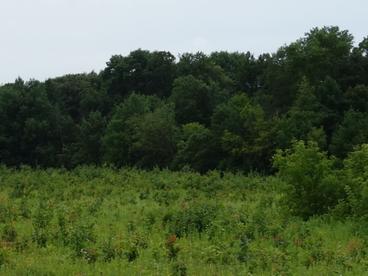
Direct Seeding of Hardwoods on a Former Agricultural Site with Observations on Soil Compaction (MN DNR)
Improve water quality, wildlife habitat, outdoor recreation opportunities and produce forest products by establishing a mixed hardwood stand on a former agricultural field.
Cover type: Other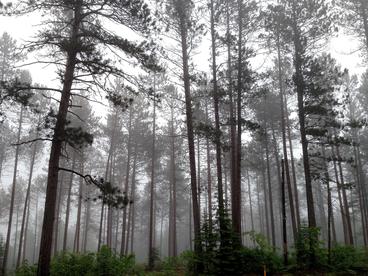
Fuels Reduction Thinning in Multi-Aged Red Pine (UMN-CFC)
To lower stand density in a spatially heterogeneous fashion, reduce fuel-loading in a mature stand by disconnecting foliage between the canopy and sub-canopy, and increase aesthetic appeal of a multi-aged red pine stand.
Cover type: Pine