46.70457, -92.534821
Study of ecological and stand dynamics changes after a single thinning from below
47.565127, -94.076095
Test silvicultural systems that adapt red pine forests to anticipated changes in climate and disturbance regime.
46.86377, -94.71895
Test the hypothesis that retaining a live seed source on a FDc23 jack pine harvest site will result in adequate natural jack pine regeneration.
46.446049, -91.51028
Regenerate a vigorous stand of jack pine that will be managed on a 48-year rotation in order to achieve timber production objectives as well as Pine Barrens ecological/wildlife objectives within Wisconsin’s Northwest Sands Landscape.
48.244194, -93.84375
Regenerate an even-aged stand of merchantable timber that is dominated by jack pine.
47.225276, -92.101334
The goal on all three stands was to decrease the overall abundance of trembling aspen, paper birch, and balsam fir while increasing the abundance of long-lived conifers such as red pine, white pine, white, and black spruce.
46.696065, -92.537739
Demonstrate the results of thinning from below (light), selection (from the top), and thinning from above (heavy crown thinning).
46.373684, -92.801131
Assess effectiveness of Velpar treatment to control understory competition in preparation for establishing natural red pine regeneration under a mature red pine canopy.
46.323033, -92.791008
Establish a fully stocked red pine stand from natural regeneration.
46.703, -92.525
To lower stand density in a spatially heterogeneous fashion, reduce fuel-loading in a mature stand by disconnecting foliage between the canopy and sub-canopy, and increase aesthetic appeal of a multi-aged red pine stand.
48.027063, -94.15836
Increase white/red pine, decrease aspen
46.705391, -92.542747
Clearcut red pine overstory and reinitiate even-aged, early-successional community while observing the effects of different skidding, processing, and biomass retention treatments on artificial and natural jack pine regeneration.
47.666, -91.271
Use an interdisciplinary approach to create a large young forest patch more representative of natural disturbances in boreal landscapes.
47.13505, -94.425895
To optimize timber returns while initiating a new even-aged stand on a site that has prominent blowdown. Promote and facilitate wildlife habitat.
46.699556, -92.524694
Promote and maintain fire-dependent forested community and conduct mid-rotation site preparation through ecocultural prescribed fire.
46.43308, -91.518213
Permanent vegetation plots were established within 5 stands in Zone 1 of the Barnes Barrens Management Area (BBMA) as a way to monitor the effects of different herbicide treatments to reduce competition with jack pine while maintaining quality habitat for
47.240113, -92.13053
Convert a poor quality aspen / paper birch stand to pine.
47.39792, -95.55734
Natural regeneration of jack pine while maintaining a robust native plant community
47.22704, -92.10348
Use the seed tree system to naturally regenerate a mixed stand dominated by red and white pine, keeping costs low with no site prep.
48.236107, -93.828197
Maintain a multi-aged stand and natural mixed pine regeneration to provide within stand structure that is lacking along this public land dominated sand ridge.
44.195694, -89.466389
The objective for this treatment is an even-aged, overstory removal of red pine in order to release white pine advance regeneration.
47.23524, -92.13472
To convert a poorly stocked and poor quality birch-dominated stand to pine using aerial seeding.
47.05776, -92.097232
Regenerate white and red pine using a shelterwood system and controlling competition with herbicide
46.775838, -94.890726
Measure ecological recovery following stand reinitiation and site preparation
47.568207, -94.027104
Use prescribed fire to prepare the site, control beaked hazel, and expose mineral soil to favor natural regeneration of white pine and red pine, with a desired future condition of a two-aged mixed pine stand.
48.608, -95.18311
Increase biological diversity of a young jack pine stand through prescribed burning.
46.691, -92.536
Regenerate an even-aged mix of red pine and white pine using a seed tree system, augmented with low density planting of red pine
48.606297, -94.975009
Increase heterogeneity and complexity of stand structure and composition while providing variable canopy cover, density of residual trees, and understory plant community development; establish openings (and later expand) to facilitate regeneration.
47.586677, -95.064547
Determine if a selected red pine plantation is declining in growth after a thinning.
46.702402, -92.528351
To test an experimental red pine natural regeneration system that balances economic and ecological factors.
47.664723, -93.262129
Use natural and artificial regeneration practices to regenerate a natural origin red pine site with characteristics that mimic a natural origin stand in structure and diversity, while maintaining red pine as the dominant species.
47.76846, -93.04353
Use natural and artificial regeneration practices to regenerate a natural origin red pine site with characteristics that mimic a natural origin stand in structure and diversity, while maintaining red pine as the dominant species.
47.666093, -92.954166
Use natural and artificial regeneration practices to regenerate a natural origin red pine site with characteristics that mimic a natural origin stand in structure and diversity, while maintaining red pine as the dominant species.
47.24034, -93.13845
Use natural and artificial regeneration practices to regenerate a natural origin red pine site with characteristics that mimic a natural origin stand in structure and diversity, while maintaining red pine as the dominant species.
47.715497, -90.87606
Establish white pine as a dominant overstory species.
47.52870385, -93.99546396
Naturally regenerate a mature pine stand to a young mixed pine stand with a significant white pine component through use of prescribed burning and seed tree harvests.
46.85694, -95.35833
Uneven aged management in a 115 year old pine stand.
47.186192, -92.049008
Regenerate red and white pine through natural seeding
48.244778, -93.5073
To regenerate jack pine after clearcutting with reserve trees, at 800 trees per acre with 95% stocking of desirable trees, 75% stocking of jack pine that is free-to-grow.
46.691877, -92.526878
This 1984 treatment was designed to demonstrate two types of reserve management: 1) mechanical restoration of open understory treatment, as a demonstration of historical stand structure maintained by surface fire regime, and 2) no treatment.
47.410257, -95.13045
Even-aged management to produce successive crops of jack and/or red pine.
46.442952, -92.437795
Develop a more structurally diverse red pine stand while increasing opportunities for natural regeneration while maintaining an economically feasible timber harvest
47.798524, -90.813093
Maintain and enhance pine patch by promoting spatial and vertical structure common to older fire-dependent pine forests. Decrease the potential for crown fire and reintroduce the role of disturbance.
47.306, -94.735
Even aged management of Red Pine. This treatment tested the effect on seedling growth of adding N to Velpar applied for competition control.
48.753137, -95.333581
Harvest standing jack pine and aerial seed back to jack pine with mechanical site prep.
46.691645, -92.533752
To reserve mature white pine for legacy and open growing space for a new cohort of white pine.
47.243077, -92.121147
To naturally regenerate white and red pine under a shelterwood system using two site prep methods: prescribed burn and salmon blade.
47.560911, -93.24452
Release jack pine from hardwood competition.

Assessing the success of group openings in recruiting mid/intolerant deciduous tree species (Haliburton Forest and Wild Life Reserve)
In this field trial, we investigated the effects of group opening treatments on the regeneration of yellow birch, black cherry, and red oak in Haliburton Forest and Wild Life Reserve, 2-3 years after implementation of the group openings.
Cover type: Northern hardwoods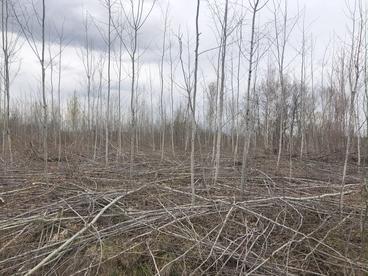
Pre-commercial aspen thinning (UPM Blandin)
Utilize pre-commercial thinning in a quaking aspen (Populus tremuloides) stand to increase diameter growth and decrease rotation age.
Cover type: Aspen-Birch
Swamp tree planting using mounding (Fond du Lac)
Restore this wetland to a culturally useful forested condition that is more resilient to human stressors, particularly climate change, than the previous forest.
Cover type: Ash
Comparing Pine Regeneration Methods and Tactics in the Cloquet Valley State Forest (MN DNR)
The goal on all three stands was to decrease the overall abundance of trembling aspen, paper birch, and balsam fir while increasing the abundance of long-lived conifers such as red pine, white pine, white, and black spruce.
Cover type: Pine
Goose Island Deer Repellent Test (US Army Corps)
The objective of the planting was to test the effectiveness of deer fence and animal protein-based deer repellent on growth and survival of swamp white oak and river birch seedlings.
Cover type: Other
Mississippi River Pool 3 Floodplain Forest Silvicultural Trials (US Army Corps of Engineers)
Promote regeneration of floodplain tree species and prevent conversion of site to reed canary grass. Provide wildlife habitat for the next 50 to 100 years.
Cover type: Other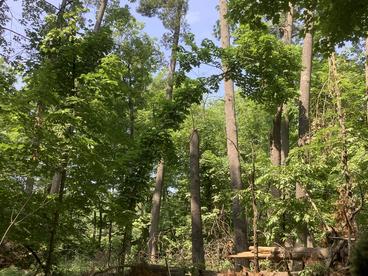
Variable Overstory Density Management for White Pine Regeneration in Two Native Plant Communities (MN DNR)
Establish or maintain uneven aged pine-mixed hardwood stands with a significant white pine component using natural regeneration.
Cover type: Mixed Woods
Shelterwood and slash walls to regenerate northern red oak and eastern hemlock (USFS)
Objectives of this stand include a shelterwood harvest, tending of the stand via understory cutting, constructing a slash wall for deer exclusion, and evaluating the effectiveness of excluding deer and the natural regeneration success.
Cover type: Northern hardwoods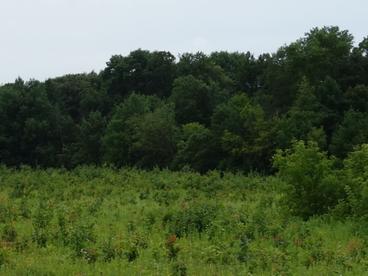
Direct Seeding of Hardwoods on a Former Agricultural Site with Observations on Soil Compaction (MN DNR)
Improve water quality, wildlife habitat, outdoor recreation opportunities and produce forest products by establishing a mixed hardwood stand on a former agricultural field.
Cover type: Other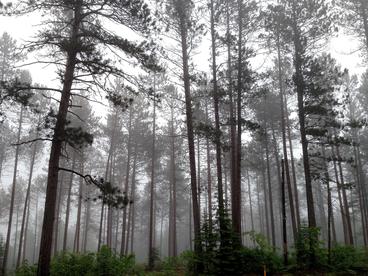
Fuels Reduction Thinning in Multi-Aged Red Pine (UMN-CFC)
To lower stand density in a spatially heterogeneous fashion, reduce fuel-loading in a mature stand by disconnecting foliage between the canopy and sub-canopy, and increase aesthetic appeal of a multi-aged red pine stand.
Cover type: Pine