
47.225276, -92.101334
On this page:
Overview
This is a retrospective case study documenting pine regeneration and plant community response in three FDn43 stands to three different regeneration methods and their associated site prep and tending treatments. Treatments included:
- Stand #1: A two-step delayed shelterwood
- Stand #2: A seed tree harvest
- Stand #3: A clearcut with reserves harvest
These stands all received a slightly different set of site preparation and tending treatments to test the success of conifer re-establishment, with a focus on pine species.
Silvicultural Objectives
Overall objectives were to maintain these stands as mixed pine/birch stands, while increasing the abundance of red and white pine as well as white spruce in the understory. Another objective was to conserve biodiversity and maintain existing native plant community (NPC) composition and structure.
Pre-treatment Stand Description and Condition
Stand Establishment, Management, and History:
These stands were a part of a 90-year-old mesic pine forest dominated by white pine and red pine. Extensive pine logging operations occurred in this area in the late 1800’s through the early 1900’s which indicate these stands were most likely planted with pine sometime in the 1930’s. After harvest at an estimated stand age of 90 years old, stands were regenerated in 2015 and were 10 years old at the time of publication.
Pre-treatment Species Composition:
Other than the red and white pine that dominated the landscape, scattered associates included jack pine, paper birch, balm-of-Gilead, trembling aspen, red maple, white spruce, black spruce, balsam fir, and tamarack. The white and red pine were mostly dominant in the canopy and somewhat uniformly distributed across the stand. All other species were co-dominant or suppressed and had patchy distribution. The tamarack and red maple were only present in the understory.
Prior to harvest, existing advance regeneration across these stands was relatively low with white pine, red pine, black spruce, white spruce, red maple, paper birch, and trembling aspen being all that was recorded.
Pre-treatment Forest Health Issues
All health threats in these stands are minor and aren’t impeding regeneration, including:
- White pine blister rust; on white pine regeneration
- Spruce budworm; damage on balsam fir and spruce species
- Pine bark beetles; (including the pine engraver species Ips pini and Ips grandicollis) on pine species
- Diplodia shoot blight potential; on red pine regeneration
There were minor incidences of white pine blister rust observed as well as signs of spruce budworm damage pre-harvest in all three stands.
Silvicultural Prescriptions
Stand #1: Two-step delayed shelterwood
This mixed white and red pine stand received an establishment cutting in the winter of 2009 (at stand age 77), initiating a two-step delayed shelterwood system with two removal cuts planned. The harvest targeted non-desired tree species, mostly aspen and white spruce with balsam fir, maple, and paper birch, as well as a very small amount of pine species that were pulp size.
Site prep followed using a ground, broadcast application of herbicide (Accord, active ingredient glyphosate, at 5qt/ac) in August 2010. A prescribed burn was completed in the spring of 2011.
The first removal cut occurred in the winter of 2015 on frozen or dry soil conditions (permit B012123). Scattered overstory trees were reserved on the site. Marked white pine, red pine, and jack pine, all white spruce less than 14” DBH and 7 sticks, and all merchantable balm-of-Gilead, balsam fir, red maple, tamarack, and paper birch were to be cut. In addition, all balsam fir, red maple, and tamarack greater than 2” DBH were to be felled. All unmarked white pine and red pine, as well as healthy-looking white spruce and black spruce greater than 14” DBH and 7 sticks, were reserved. Average residual BA in Stand #1 is 40 (range 30-50) where 75% of residual BA is white pine and 25% is red pine with about 15% crown closure.
A post-harvest release treatment included a chemical ground application of herbicide (Rodeo, active ingredient glyphosate, at 5qt/ac) in August 2016 to reduce hardwood and shrub competition.
If there's enough overstory volume, the second and final removal cut is planned for 2028.
Stand #2: Seed tree
This pine stand was thinned in 2003 (at stand age 71) to release residual pine likely following the specification in stand #1.
In the spring of 2005, this site was aerial seeded with white pine. Seeding rates were not available from records, but full stocking would require 8 oz. of white pine seed per acre.
Prior to the 2015 seed tree harvest average BA was 68 (range 20-160). The forester noted at the time there was adequate regeneration stocking. Regeneration surveys at that time revealed the following densities (TPA) in the 0-1” DBH class: 650 paper birch, 380 white pine, 350 aspen, 280 white spruce, 150 balsam fir, 140 red pine, and 70 jack pine.
A seed tree harvest was completed in the winter of 2015 following the exact same harvest specifications and details as stand #1. Average residual BA was variable. A portion of the stand had average BA of 30 (range 20-40), but in the NE portion of the stand the average residual BA was 60 (range 50-70). 50% of the residual BA is white pine and 50% is red pine with about 5-30% crown closure. Regeneration was most dense where crown closure was highest.
A post-harvest release treatment occurred in August 2016 with a chemical ground application of herbicide (Rodeo, active ingredient glyphosate, at 5qt/ac).
If there's enough overstory volume, seed trees will be harvested in 2028.
Stand #3: Clearcut with reserves
A clearcut with reserves harvest was completed in the winter of 2015 where all unmarked white spruce, black spruce, white pine, red pine, and paper birch, and all merchantable trembling aspen, balsam fir, and red maple were cut. All white spruce, black spruce, white pine, red pine, and paper birch marked with yellow paint were reserved. The harvest was only allowed to be conducted on frozen or dry soil conditions.
Post-harvest treatments included hand planting of containerized white pine at 815 TPA in the spring of 2015 followed by bud capping each year from 2015-2019. In the summer of 2020, a brush saw hand release was conducted to reduce competition.
Table 1: Summary of characteristics for the three study stands.
| Stand 1 | Stand 2 | Stand 3 |
|---|---|---|---|
| Acres | 37 ac | 17 ac | 7 ac |
| Silvicultural System | Two-step delayed shelterwood | Seed tree | Clearcut with reserves |
| Site index (species) | 62 (white pine) | 66 (red pine) | 51 (balsam fir) |
| Age at start of treatments | 77 | 71 | 83 |
| Timber harvest and site prep treatments |
|
|
|
| Post-harvest treatments |
|
|
|
| Treatment costs | $540/acre | $143/acre | $580/acre |
| Current age | ~15 years old | ~20-10 years old | ~10 years old |
| Residuals (basal area or BA; sq. ft./ac.) | Average 40 (range 30-50) | Average 30 (range 20-40) | <10 |
| Regen results (trees/acre; TPA) | White pine: 4,076 TPA | White pine: 916 TPA | White pine: 643 TPA |
What Actually Happened during Treatments
Prescriptions were implemented as planned. Harvesting was done with conventional logging equipment. A feller-buncher was used to fell timber and a grapple skidder to establish trails and pull logs out to the landing where timber was processed. Slash was chipped and utilized for biomass in all three stands.
Post-Treatment Assessment
Methodology of Data Collection:
Tree regeneration, ground layer species, and cover composition were surveyed at plots randomly established on a grid at approximately 1 plot/acre on each stand. Tree data collected at each plot included:
- Regenerants: < 1” diameter and under 1’ foot tall. 1/100th acre plot.
- Seedlings: <1” diameter and over 1’foot tall. 1/100th acre plot.
- Sapling: 1-3” diameter. 1/100th acre plot.
- Small trees: 3-5” diameter at breast height. 1/100th acre plot.
Major Conclusions of Study:
In 2022 following the treatments in stand #1, nearly 3,000 trees per acre (TPA) and about 80% of the recorded regeneration were found to be long-lived conifer regenerants and seedlings (white pine, red pine, and spruce species; Figure 1). In 2025, the red and white pine regeneration more than doubled to 7,000 TPA (Figure 4).
Following the treatments on stand #2, nearly 2,000 TPA and about 55% of the recorded regeneration were found to be long-lived conifers (Figure 2). It is also noteworthy that balsam fir was responsible for about 43% of the TPA alone. By the 2025 survey, white and red pine regeneration densities increased to nearly 2,500 TPA. Balsam fir had also maintained abundance at 1,250 TPA (Figure 5), likely due to lack of fire and other disturbance like broadcast herbicide.
Following the treatments on stand #3, about 500 TPA and 11% of the recorded trees per acre were found to be long-lived conifers, with no red pine observations. Aspen accounted for the majority of what was growing back, comprising 80% of the regenerant and seedling category. This may have been due to there being more mature aspen in or near this stand compared to the other two stands as well as minimal site prep and release. The 2025 survey revealed white pine had increased its abundance to 643 TPA while aspen was reduced to 2,014 TPA (Figure 6).
The original desired future conditions were to maintain the NPC and species compositions to a long-lived, conifer-dominated pine stand with spruce in the understory. At this rate, and with the help of an additional brush saw release on each site, these objectives will be met with full success. Each stand took its own journey to get there but all are considered stocked with species that match the original goals.
Overall, the best outcome for a mix of natural long-lived conifer establishment and recruitment was in Stand #1 where we used a two-step delayed shelterwood with two removal cuts (the first occurred in 2015, 6 years after the establishment cut; the final cut is planned for 2028), a site prep spray, a prescribed burn, followed by a well-timed release spray. This particular set of treatments saw the most successful red and white pine regeneration in this study. There were more steps in the treatment plan which led to an outcome with abundant and diverse long-lived conifer. This prescription is a great example of the careful planning, monitoring, adaptive management, and dedication required to naturally regenerate pine on more mesic, fire-dependent sites.
The native plant communities across these three stands were very similar, the biggest change being the addition of disturbed site species such as orange and yellow hawkweed, common daisy, common dandelion, common yarrow, common tansy, and multiple clover species post-treatments. These species were found abundantly across the forest floor along with species found pre-treatments such as blueberry, dwarf raspberry, common strawberry large-leaved aster, wild sarsaparilla, and hazelnut and honeysuckle species. The disturbed site species should eventually fade out after stand re-establishment is complete and the canopy starts to close, returning the NPCs back to their original composition and structure.
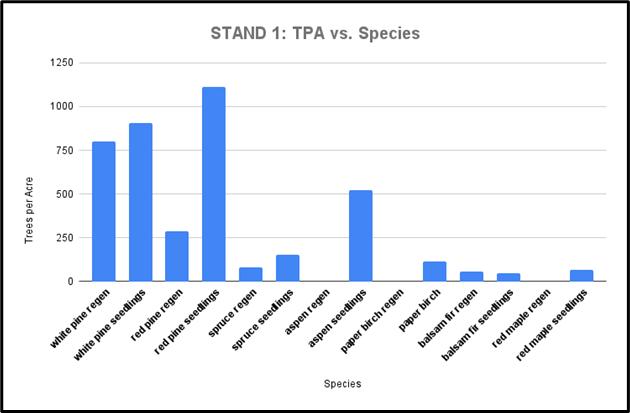
Figure 1: Results of 2022 regeneration survey in Stand 1 (two-step shelterwood with broadcast herbicide, Rx burn site prep, and post-harvest chemical release). In the figure, “regen” refers to regenerants under 1 ft. tall and “seedlings” refer to seedlings greater than 1 ft. tall but less than 1 in. DBH.
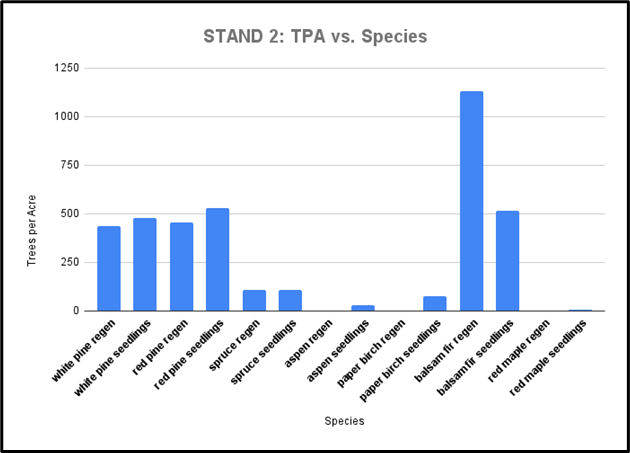
Figure 2: Results of 2022 regeneration survey in Stand 2 (seed tree with aerial white pine seeding and post-harvest chemical release). In the figure, “regen” refers to regenerants under 1 ft. tall and “seedlings” refer to seedlings greater than 1 ft. tall but less than 1 in. DBH.

Figure 3: Results of 2022 regeneration survey in Stand 3 (clearcut with reserves with hand planted white pine plug seedlings, bud capping, and brush saw). In the figure, “regen” refers to regenerants under 1 ft. tall and “seedlings” refer to seedlings greater than 1 ft. tall but less than 1 in. DBH.
2025 Update
After 3 years since this study first started in 2022 updated regeneration monitoring found the following changes in species density.

Figure 4: Results of 2025 regeneration survey in Stand 1 (two-step delayed shelterwood with broadcast herbicide, Rx burn site prep, and post-harvest chemical release).

Figure 5: Results of 2025 regeneration survey in Stand 2 (seed tree with aerial white pine seeding and post-harvest chemical release).

Figure 6: Results of 2025 regeneration survey in Stand 3 (clearcut with reserves with hand planted white pine plug seedlings, bud capping, and brush saw).
The recent set of regen surveys have shown that each stand is well stocked and on their way to becoming fully reestablished mature pine stands. The original desired future conditions were to maintain the NPC and species compositions of a long-lived conifer dominated pine stand with spruce in the understory. At this rate, and with the help of an additional brush saw release on each site, these objectives will be met with full success. Each stand took its’ own journey to get there but all are considered stocked with species that match the original goals.


Figures 7, 8, and 9: A look at Stand 1 (two-step delayed shelterwood with broadcast herbicide, Rx burn site prep, and post-harvest chemical release) in 2025.


Figures 10, 11, and 12: A look at Stand 2 (seed tree with aerial white pine seeding and post-harvest chemical release) in 2025.


Figures 13, 14, and 15: A look at Stand 3 (clearcut with reserves with hand planted white pine plug seedlings, bud capping, and brush saw) in 2025.
Plans for future treatments
These stands will continue to be monitored closely over the next 5 years. Post-harvest stand monitoring will inform future treatments as needed. All three stands will also most likely see a brush saw release sometime over the next 5 years to open more growing space for desired conifer species. Removal of overstory residuals in Stand #1 and the seed trees in Stand #2 will occur in approximately 3 years (2028) if enough overstory volume is found.
Costs and economic considerations
Timber revenue for Stands 1 and 2 were higher than for Stand 3, but it is difficult to say why based on available records but could have been due to stand size, access, and available forest products.
Reforestation costs were lower for Stands 1 and 2 and far more pine seedlings were established in those stands compared to Stand 3 that was clearcut and planted. The higher costs for establishing Stand 3 were due to the cost of planting and tending, including several years of protecting planted white pine from deer with budcapping.
Some costs were not available in the records, and instead, average practice costs from 2025 were used. That was the case for the following costs: Rx burn, site prep spray, chemical release, and budcapping.
Table 2: Summary of timber revenue and reforestation costs by case study stand.
| Stand 1 | Stand 2 | Stand 3 | ||||
|---|---|---|---|---|---|---|---|
| Acres | 37 | 17 | 7 | ||||
Per acre | Total | Per acre | Total | Per acre | Total | ||
Timber Revenue | Shelterwood (Establishment cut + first removal cut) | $ 1,330 | $ 49,210 | - | - | - | - |
| Seed tree | - | - | $ 1,330 | $ 22,610 | - | - | |
| Clearcut | - | - | - | - | $ 1,067 | $ 7,472 | |
| Total | $ 1,330 | $ 49,210 | $ 1,330 | $ 22,610 | $ 1,067 | $ 7,472 | |
Refor. Costs | Site prep spray | $ (125) | $ (4,625) | - | - | - | - |
| Rx burn | $ (290) | $ (10,730) | - | - | - | - | |
| Planting | - | - | - | - | $ (190) | $ (1,330) | |
| Aerial seeding | - | - | $ (18) | $ (306) | - | - | |
| Chemical release | $ (125) | $ (4,625) | $ (125) | $ (2,125) | - | - | |
| Brushsaw release | - | - | - | - | $ (165) | $ (1,155) | |
| Budcapping | - | - | - | - | $ (225) | $ (1,575) | |
| Total | $ (540) | $ (19,980) | $ (143) | $ (2,431) | $ (580) | $ (4,060) |
| Balance | $ 790 | $ 29,230 | $ 1,187 | $ 20,179 | $ 487 | $ 3,412 | |
Summary / lessons learned / additional thoughts
This is a retrospective case study to monitor the regeneration and plant community response in three FDn43 stands. The goal of the study is to continue to expand our knowledge on mesic pine management in NE Minnesota and to find ways to maintain conifers representative of the NPC where appropriate. These sites are found on well drained loamy sand soils. The evaluated silvicultural systems were a two-step delayed shelterwood harvest with two removal cuts (Stand #1), a seed tree harvest (Stand #2), and a clearcut with reserves (Stand #3). The biggest difference between these three stands were the site prep and post-harvest tending treatments, including varying regeneration establishment and competition control methods. Findings include the highest levels of natural regeneration of red and white pine within the two-step delayed shelterwood and seed tree treatments, and lower levels of white pine regeneration in the clearcut with reserves harvest.