
43.731906, -91.230083
On this page:
Overview
We wanted to test whether deer repellent would be useful in bottomland hardwood forests on the Mississippi river, and how deer herbivory was affecting tree regeneration. We decided to initiate a stand along the road at the Goose Island campground, as this area has the highest deer population of any area in our district. We are comparing the growth and survival of river birch and swamp white oak planted inside exclosures and outside exclosures, as well as those treated with repellent and a control group. Initial results indicate that repellents are not cost effective.
Bottomland Hardwoods
River or stream name:
Mississippi River
River or stream type:
Major river
Floodplain or terrace:
Terrace
Floodplain topographic position:
Bottom
Silviculture Objectives
The primary objective of the planting was to test the effectiveness of deer fence and animal-protein based deer repellent on growth and survival of swamp white oak and river birch seedlings. The secondary objective was to initiate a stand of trees to serve as a screen between the road and the campground.
Pre-treatment stand description and condition
Stand establishment and management history
This stand was formerly a plantation of red pine, which was reduced to a few residual trees in the early 2000s and fully cleared in 2020.
Pre-treatment species composition
Prior to treatment the stand was afforested except for a short row of red pine remaining on a portion of the western border. The ground cover was mostly reed canarygrass and other turfgrasses.
Pre-treatment forest health issues
The area was not appropriate for red pine and where elevation was lower in the north third, the red pine had died. Deer population is very high at Goose Island as hunting is off limits.
Landowner objectives/situation
Regenerate terrace forest trees to provide a screen between the road and campground.
Silviculture Prescription
In 2022 a planting was planned on Goose Island in Shelby, Wisconsin. Cover within the planting area was mowed grass. There is a depression in the northern portion of the planting area that holds water after large rain events, while the central portion of the planting area is on a higher elevation sandy ridge. The planting area was divided into 3 subsections of approximately 0.2 acres each. An 8 foot tall plastic mesh deer fence was built to enclose the southern section, the middle section was to be unprotected from deer, and the northern section was to be treated with an animal protein-based deer repellent (containing animal blood meant to produce an odor) early in the growing season each year. The site was planted at a 6 x 6 spacing in spring of 2022. Trees were planted in a pattern with two rows of swamp white oak followed by a third row of river birch. In the fenced area, a 6 foot buffer was maintained between the last tree in the row and the deer fence to allow for access with maintenance equipment. The tree locations were sprayed with a broad spectrum herbicide prior to planting and in each of the first two years post-planting. The site was mowed between rows monthly from May through September in the first four years following planting. Deer repellent was applied in the repellent treatment area for two years following planting, with half of the area being sprayed in May or early June only and half being sprayed in spring as well as in November of each year.

Figure 1: A swamp white oak that was sprayed with repellent.
What actually happened during the treatment
We decided to intersperse several replications of the control and repellent treatments instead of just using three large blocks as originally planned (see Figure 2). This allowed us to avoid confounding the repellent and control treatments with the high vs. low elevation areas.
Leaf damage was observed on seedlings that were sprayed with repellent in June of both years. The leaves had not yet developed waxy cuticles, and the repellent seemed to have desiccated them.
The fence was effective at keeping out deer, but also required maintenance to patch holes and keep from sagging. While mowing was used to maintain the seedlings, grass directly next to the fence could not be mowed and grew up. Rabbits browsed seedlings in all treatments, but herbivory was especially heavy on swamp white oaks inside the fence and was the main cause of mortality for oaks inside the fence. It is possible the rabbit damage was worse there because of cover provided by the grass alongside the fence.
The northern 2/3 of the repellent and control treatments were in a low-lying area, which flooded during 2022. Some flooding also occurred inside the fence. The southern 1/3 of the repellent and control treatments were on high sandy soil directly next to the remaining red pines. The trees here grew more slowly and seemed suppressed by browse more easily than those in the lower lying areas.
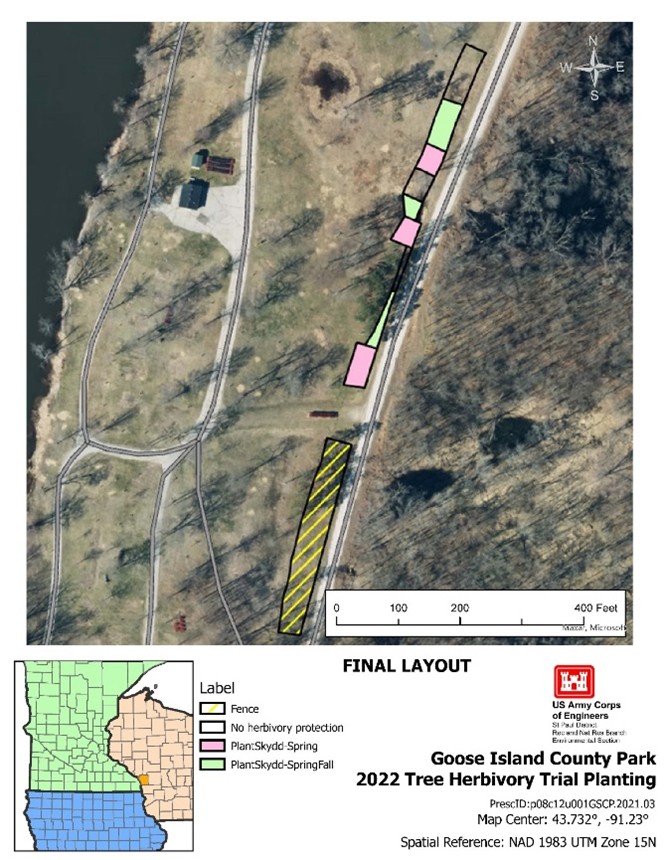
Figure 2: Experimental Layout of the deer repellent screening planting.
Post-treatment assessment
After four years, both species had good survival and growth. River birch survival was 100% inside fences and where repellent was applied in both spring and fall. Fencing resulted in greater survival than the control group. Within the fence all trees had an average survival of 95. ± 3% compared to 73 ± 8% outside.

Figure 3: Trees inside the fence in February 2026 after four growing seasons

Figure 4: Untreated trees in February 2026 after four growing seasons. White-tailed deer in background.
Fences protected all trees from browse, and resulted in greater river birch height growth than controls and repellent treatments, as well as greater river birch diameter growth than both controls and repellent treatments. River birch had already reached free-to-grow status after 2 years inside fences. Fencing also increased height growth over all other treatments in swamp white oak, and resulted in greater swamp white oak diameter growth than controls and spring-only repellent treatments by the third growing season. However, the control group had grown enough to reduce any statistical difference by the fourth growing season for both height and diameter. By year 4, the growth of swamp white oaks had also eliminated any difference in diameter between fenced trees and those where repellent was applied twice per year (the best performing repellent treatment). Analysis of the browse severity after the third growing season showed that, while fencing had a significant effect in decreasing the probability of browse, repellent treatments had no effect. River birch was 3 times more likely to be in a higher browse category than swamp white oak. River birch growth after three growing seasons was 0.8ft higher where repellent was reapplied twice per year than the control group, however, this small effect disappeared after the fourth growing season. Repellent reapplied twice per year had no statistical effect on swamp white oak, though it was 0.3 feet taller in this treatment after three growing seasons.
River birch height growth was lower after four years where repellent was applied only once compared to the controls (2.2 feet where repellent was applied vs. 6.3 feet in controls).
100% of the river birch trees inside the fence reached free to grow status, meaning they were at least 5 feet tall and their terminal buds were safe from herbivory (Figure 5). Trees treated once per year with repellent had the lowest odds of reaching free to grow status (20% for both birches and oaks). Oaks outside the fence had a 33 ± 1% chance of reaching free to grow status, while those inside had a 60 ± 1% chance of reaching free to grow status. It is clear that spring only repellent applications were minimally effective, and that no repellent treatments were as effective as fencing.

Figure 5: % of Seedlings at Free to Grow Status (4.5 feet or taller) after 4 growing seasons across all treatments. RB = river birch and SWO = swamp white oak.
The minimum stocking goal is to have at least 332 free to grow trees per acre, with full stocking being between 833 and 1455 trees per acre depending on the ecosystem. All treatments except for the spring only repellent applications resulted in reaching minimum stocking levels.
Table 1: Stocking level of seedlings at free to grow status (4.5 feet or taller) after 4 growing seasons across all treatments.
| Species | Treatment | Current Stocking | % Min. Stocking Goal | % of Max Stocking Goal Achieved |
|---|---|---|---|---|
| Birch | Control | 641 tpa | 193% | 44% |
| Oak | Control | 399 tpa | 120% | 27% |
| Birch | Fenced | 1210 tpa | 364% | 83% |
| Oak | Fenced | 726 tpa | 219% | 50% |
| Birch | Spring and Fall | 569 tpa | 171% | 39% |
| Oak | Spring and Fall | 569 tpa | 171% | 39% |
| Birch | Spring Only | 242 tpa | 73% | 17% |
| Oak | Spring Only | 242 tpa | 73% | 17% |
Plans for future treatments
The fence will be removed at the beginning of 2027 (year 6). Due to high density of surviving and fast-growing seedlings, the river birches will likely need to be thinned in a crop-tree release by year 10.
Costs and economic considerations
The fence materials cost $2.06 per linear foot. Other costs included seedlings and labor. Cost of deer repellent was minimal, mostly labor. A fence as small as we used (less than a half acre covered) is not cost-effective for the amount of trees protected. However, cost-effectiveness goes up with the size of a fenced area as well as with planting density. Given that fencing doubled the number of trees, a large enough area would be cost effective to fence, especially for birches, which had 100% success rate inside.
Including both labor and materials, the repellent cost was $407 to spray the ~138 seedlings over two years for the spring application, and $814 to spray the ~138 seedlings over two years for both the spring and fall applications.
Summary / lessons learned / additional thoughts
The test was successful. While the fence was successful, we will likely use other methods in the future such as tree shelters and dense willow plantings to protect seedlings, especially in lower lying areas with more frequent flooding, which could tear down a fence. Repellents will not be used in the future.
Supplemental content

Supplemental figure 1: Height Growth (ft) of river birch and swamp white oak in the fourth growing season after planting across deer herbivory deterrent treatments.
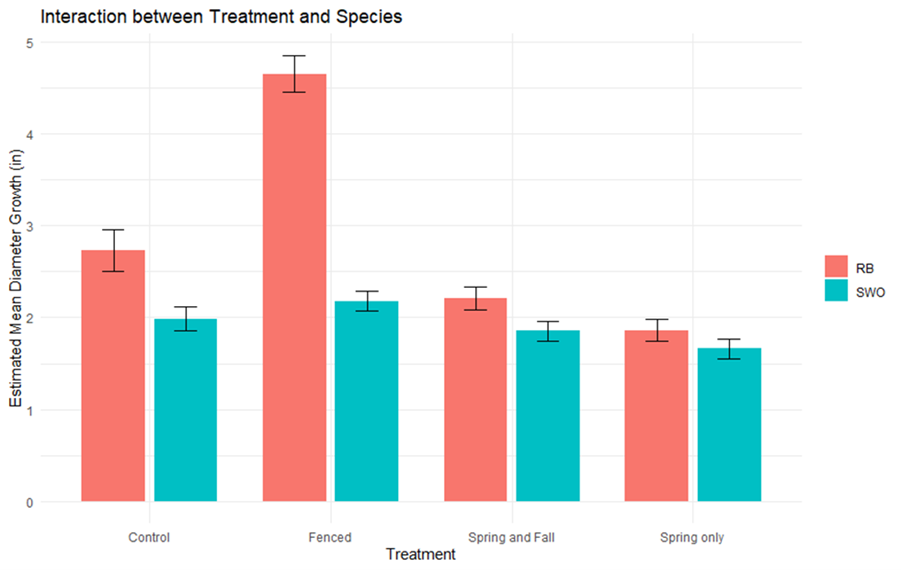
Supplemental figure 2: Diameter (inches) of river birch and swamp white oak in the fourth growing season after planting across deer herbivory deterrent treatments.